
BYD Seal Price and Trim Levels (USD Focus)
The BYD Seal is listed in export markets with U.S. dollar-equivalent pricing ranging from about US$46,990 to US$61,990 before on-road costs in one review of the 2025 model. Zecar Earlier estimates for the 2024 model suggested a base price in the US market range of about US$45,000-US$52,000. MotorTrend The trim levels typically include a base “Dynamic” variant (single motor RWD, smaller battery), a “Premium” variant (larger battery, more power) and a “Performance” variant (dual motor AWD). In USD terms the higher trims approach the US$60k level. Buyers looking at BYD Seal price and trim levels in USD should therefore budget accordingly, depending on battery size, motor configuration and optional features.
Global BYD Seal Price Expectations (USD Equivalent)
Globally, BYD sets aggressive pricing to undercut many legacy EV competitors. One summary shows that the BYD Seal electric sedan was priced from ~US$49,888 to US$68,748 before on-road costs in certain markets. Zecar In China the local price (converted to USD) for certain versions is around US$24,500 to US$33,500 for the 2025 Seal EV. Electrek These variations reflect market taxes, subsidies, battery size and local manufacturing. For the USD-conscious buyer, the expectation is that BYD Seal price offers strong value compared to many premium EV sedans, even after translation to dollars, though regional deliverables and specs may vary.
Electric Range and Performance Review
In terms of electric range and performance the BYD Seal hits strong figures. The large battery variants deliver up to about 570 km claimed range (roughly ~354 miles) under some test standards. Performance in the top trim sees 0-60 mph (0-100km/h) in around 3.8 seconds in AWD mode in select versions. The base models with smaller battery offer somewhat longer 0-100km/h times (~7-8 seconds) but still respectable. The USD priced trims thus offer a mix: the entry-level allows good everyday use and range, while the upper trims rival performance sedans. Real-world tests note that highway and cold weather conditions affect range, but the BYD Seal remains competitive in its class when considering USD price vs specs.
Interior Features and Driving Comfort
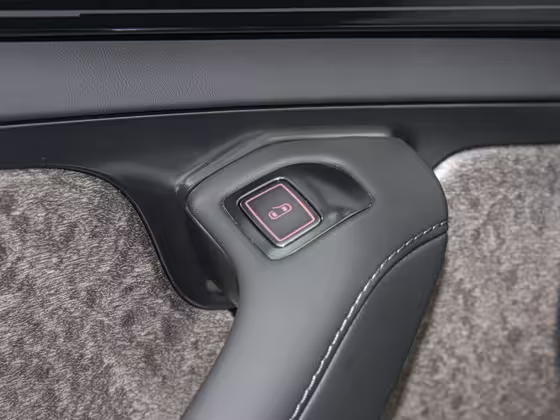
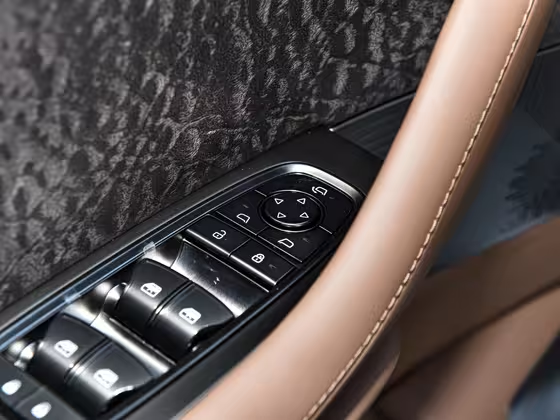
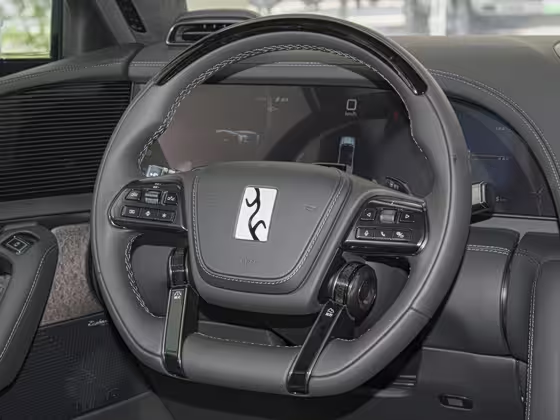
Looking at the interior of the BYD Seal, at the USD price point it offers premium features: soft-touch materials in major areas, large rotating infotainment screens, digital instrument cluster, ambient lighting, good seating comfort and a spacious cabin. One review mentions that the cabin design suggests a more upscale vehicle given the price. Driving comfort is described as refined when up to speed, with supportive seats and solid build quality for the USD segment. Some minor critiques highlight that on very rough surfaces the ride is less composed than ultra-luxury models, but for the price it’s strong value. Buyers assessing BYD Seal price and interior features find a compelling package for USD budgets under US$60k.
BYD Seal vs Tesla Model 3 Comparison (USD Pricing Focus)
Comparing the BYD Seal with the Tesla Model 3 from a USD-price perspective:
-
Price: The BYD Seal USD-equivalent pricing starts in the mid US$40k‐US$50k range for export markets, while many Tesla Model 3 trims start higher in several markets. One source indicates Tesla’s base in certain markets around US$50k+.
-
Range & Performance: The BYD Seal large-battery trims (~US$50-60k) provide range and acceleration close to many Model 3 versions; for example ~570 km (~354 miles) claimed and ~3.8 s 0-100km/h in top trim. The Model 3 Performance version is still very capable, but cost is higher.
-
Interior & Features: At the USD price point, the BYD Seal delivers features and quality that challenge the Model 3’s value proposition. Some reviews argue the interior feel of the Seal—given its price—is superior to many rivals including Model 3 at the same budget.
-
Brand & Ecosystem: Tesla has established charging infrastructure and brand prestige globally, which is a strength beyond just USD price. BYD is rapidly expanding but in many regions the charging network or brand familiarity may be less established.
In short, for buyers with USD budgets looking for maximum value per dollar, the BYD Seal presents a compelling alternative to the Tesla Model 3: similar technology, competitive range/performance, and strong features at a lower USD price. But if your priority is global infrastructure, resale value and brand familiarity—then the Model 3 still maintains advantages.
Conclusion
For shoppers monitoring USD price, the BYD Seal offers a very attractive proposition: a multi-trim EV sedan starting in the mid US$40k range up to around US$60k for high-spec. It combines strong electric range, good performance, premium interior features and value. When compared to the Tesla Model 3 on a dollar-for-dollar basis, the Seal holds its own and often beats many rivals in value. If your market supports BYD’s service infrastructure and you focus on value versus brand legacy, the BYD Seal is a top contender in the EV sedan space at its USD price.












 English
  Chinese
  Russian
  Arabic